In light of the history-making UN Resolution Declaring the Trafficking and Racialized Chattel Enslavement of Africans as the Gravest Crime Against Humanity, we continue to reflect on the importance of remembrance, memory, and the stories that shape us. The resilience, resistance, and the enduring spirit of those who came before us are woven into these stories, bringing medicine when we look. Tending to rituals of remembrance serves both as honoring and fortification of this wisdom and will for the future.
In that spirit, we share the following excerpted remarks by Dr. Joanne Braxton originally delivered as a keynote address entitled “Crossing Consciousness: Birthing Deep River” at Black Liberation in the Americas, Biennial Conference of the Collegium for African American Research at the University of Muenster, Germany in March 1999. The call to visit African American “sites of memory” remains vital today, especially in this historic moment, coinciding with both the United Nations resolution for repair and the celebration of the 250th anniversary of the founding of the United States.
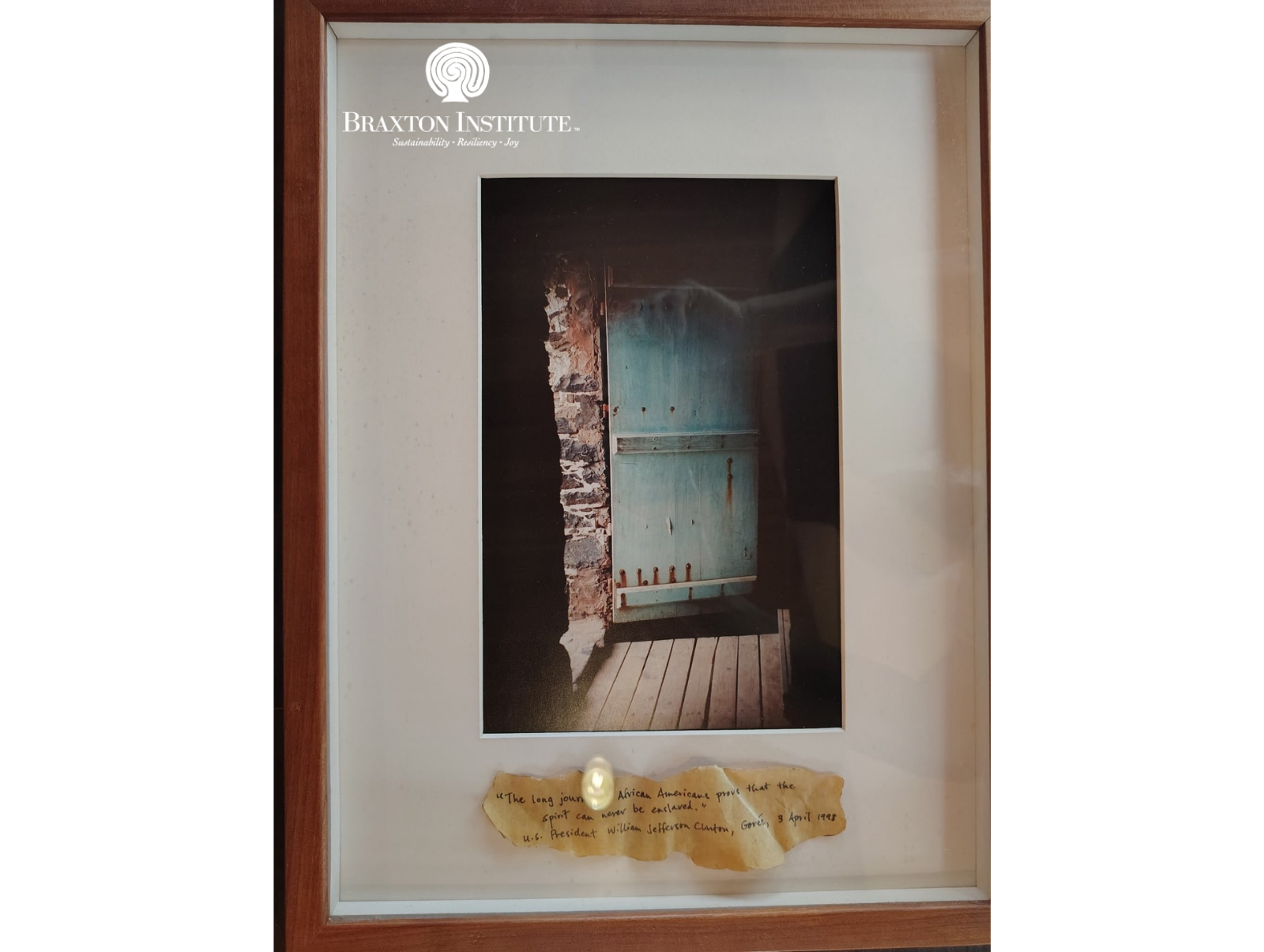
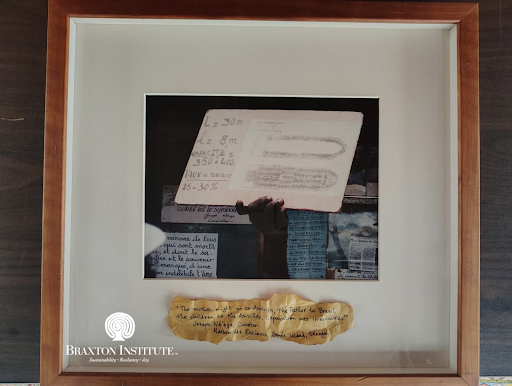
Note: The photos in this essay are from the African Odyssey exhibition, to be shown at the Montpelier Mansion national historic site in Laurel, Maryland from June 11-November 1, 2026 as part of the Braxton Institute’s “Interventions” into the re-telling of our nation’s history on its 250th birthday. African Americans must tell our own story and intervene in interpreting the very spaces where crimes against humanity, and specifically crimes against our people, occurred. Together with the United Nations and people of conscience everywhere, we insist that the story of our people must be told and that repairs must be made. For more information on the exhibition, click here.

Some years ago, I participated in a pilgrimage to “sites of memory” in Ghana, Ivory Coast and Senegal as I was beginning to write the play, Crossing a Deep River: A Ritual Drama in Three Movements, an experimental ensemble piece about the Atlantic slave trade for actors, dancers and musicians.
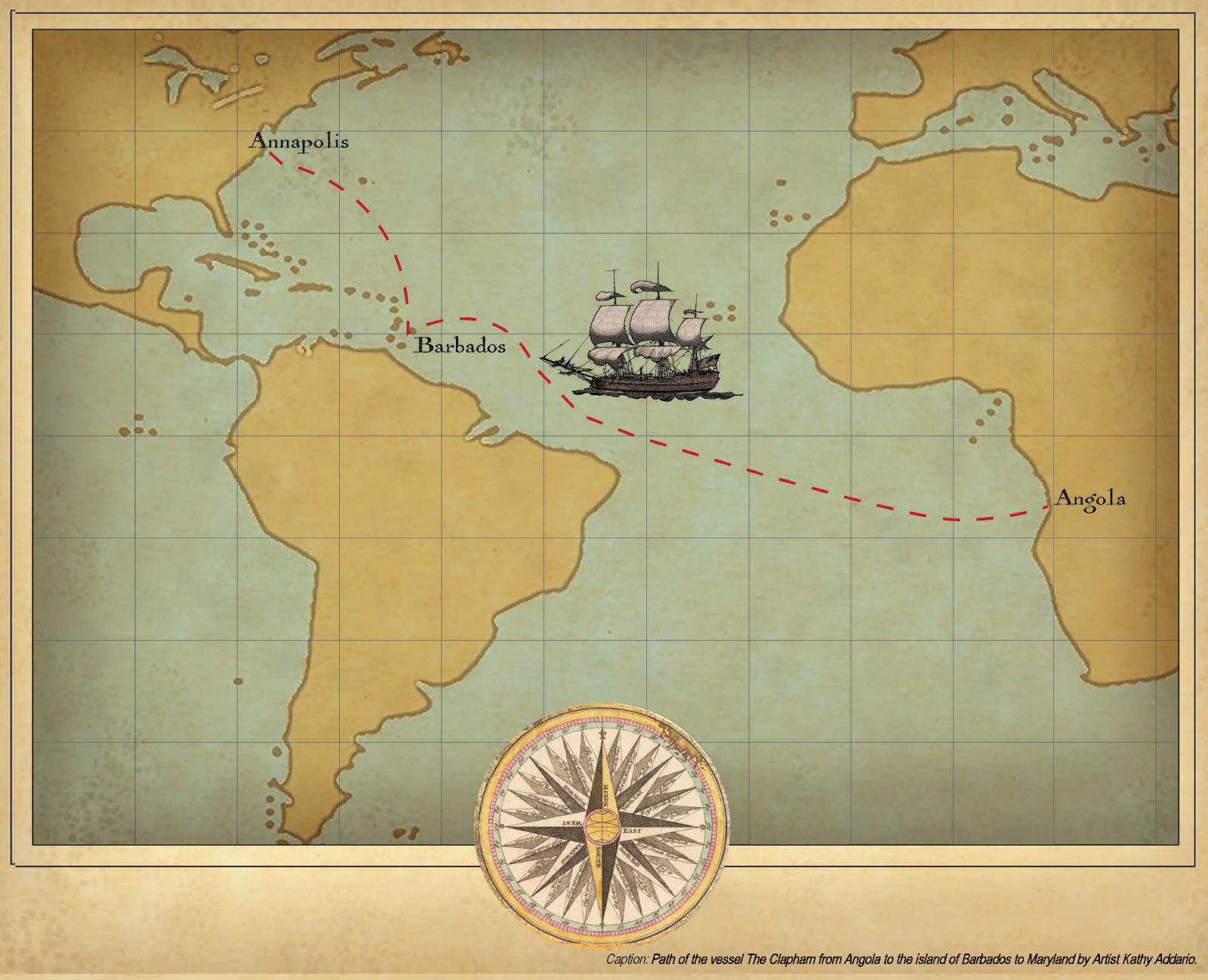
The first mention of the Middle Passage that I can recall came from my grandmother, Emma Margaret Harrison, who told me, “My father always said that we have a home over there.” “Over there” did not refer to Heaven or Canaan, but to Africa. Her father, William Harrison, enslaved on Montpelier, an estate near Laurel, Maryland until he was eight years old, had passed this memory on to his daughter, and she in turn to her son and his children. This oral transmission from generation to generation becomes a form of sharing and a ritual of remembrance steeped in what I call “crossing consciousness,” her awareness that the Harrison family had been held in bondage by the Snowden and Thomas families, Maryland Quakers directly involved in the importation of enslaved Africans into Maryland in the 18th century.
Such consciousness has long been a part of the African American experience. On the southern plantation, suppressed memories of the Middle Passage surfaced in what Booker T. Washington referred to as whispered conversations:
In the slave quarters and even later, he writes, I heard whispered conversations among the colored people of the tortures which the slaves, including, no doubt, my ancestors on my mother’s side, suffered while being conveyed from Africa to America.
The same repressed memory surfaces in 1852, in Frederick Douglass’ What to the Slave is the Fourth of July? Taking up, in his words, “the plaintive lament of a peeled and woe-stricken people,” he invoked the 137th Psalm and with it a sacred memory:
By the rivers of Babylon, there we sat down. Yea! We wept when we remembered Zion. We hanged our harps upon the willows in the midst thereof. For there, they that carried us away captive, required of us a song; and they that wasted us required of us mirth, saying, Sing us one of the songs of Zion. How can we sing the Lord’s song in a strange land? If I forget thee, O Jerusalem, let my right hand forget her cunning. If I do not remember thee, let my tongue cleave to the roof of my mouth.
I have made many journeys in search of knowledge of African people that I had not been able to find in books. In a watery dungeon beneath the Mercado Modelo in Bahia, Brazil, I had the strange experience of hearing the voices of people I could not see: men, women, and children weeping and moaning. Opening to these voices and those of the dispossessed Africans whose 18th and 19th century narratives that after nearly a quarter century of teaching I know almost by heart, I began an inner journey even into the waters of the Atlantic itself.
As a certified master scuba diver, in the waters of Bonaire, an Island in the Netherlands Antilles, I heard voices similar to the ones beneath the Mercado Modelo. This occurred at a depth of ninety feet at a dive site called “Invisibles,” a barren stretch of underwater seascape opposite a series of salt flats where Africans had been forced to mine this “white gold.” Back on board the dive boat, I could see on shore the stone pyramids where rebellious slaves had been staked and left to “dry out.”
Invisibles
Windward, never leeward, always windward,
Breathing toward Africa, four by five feet,
Thatched with palm, these exile houses, empty now,
Alone on the stony beach, except for tourists from America,
Come with our cameras and measuring tapes.
Incredulous in Bonaire, island of coral rock
Where even scrub cannot grow.
Mountains of salt at our backs,
Pink, gray and white as far as the eye can see.
They faced East, a pinnacle of torture between them and the sea
Some refused to work and raised the cry,
“I am a man,” stripped and staked to the thing to dry out,
Wind whipping salt and sand like a knife,
An inhospitable place, a bad place to die.
Just offshore, the brother guide nervously introduces “Invisibles”:
No further explanation, no particular hazards,
Nothing particular to see.
“Invisibles” is what you don’t see.
Clearest water in the world.
Ninety feet, turquoise clear to the bottom.
Dropping over the side like a stone, I equalize,
Weightless in descent and eerie silence.
Down and down and down, seventy feet.
Immense flats of sand loom white as the salt above.
Someone who knew this place never became anyone’s ancestor.
Down and down and down, eight-five feet, ninety feet.
Suddenly, the crazy singing of the Saints.
This lamentation is not nitrogen;
And not a living soul can make a
Sound at ninety feet.
Yet, I am not in harm’s way.
These, who might have been my ancestors,
Beseech me to “Bear Witness,”
And I ascend, following a trail of bubbles.
Below a black tipped reef shark glides along a boney drop off,
Feasted on African souls of Yoruba and Fanti.
Back on deck, the guide looks fathoms into my eyes and smiles.
“Invisibles,” I respond.
And he, “Invisibles.”
"Invisibles" is about collective memory and the importance of bearing witness, of making and keeping rituals of remembrance, wherein the intellectual and the spiritual converge. The King of the Netherlands made an apology for the country's involvement in slavery in 2023.
It has been said that the future of a people can only be illuminated when founded on the past. Crossing consciousness presents itself in the memory of the earliest slave narrators, from Belinda Sutton Royall, a Yoruba woman kidnapped as a child and sold into slavery in New York in the 18th century, and Quobna Ottobah Cugoano, an Akan youth transported around the same time, remembered by Frederick Douglass and Booker T. Washington, among others. Even today, it remains part of the African American inheritance. Like the bag of bones that Pilate carries around with her from place to place in Toni Morrison’s Song of Solomon, crossing consciousness signifies what Morrison has called the presence of the ancestor, and it informs the vision of countless artists working in multiple and sometimes mixed genres. An interplay of history and sacred memory, crossing consciousness manifests itself in dreams and visions, music, painting and sculpture, literature and film, as well as other forms, stimulating new levels of awareness, creativity, understanding and analysis.
My play, Crossing a Deep River: A Ritual Drama in Three Movements, is the flowering of the seed planted by my grandmother long ago when she rocked me to sleep and whispered, “We have a home over there.” The words “over there” were part of a life occluded and hidden, a whisper that remained in our privileged and private sphere, and therefore safe.
In The Secret Life of Plants the authors observe that, “A climbing plant which needs a prop will creep toward the nearest support,” and that “if a plant is growing between obstructions and cannot see a potential support it will unerringly grow toward a hidden support, avoiding areas where none exists.” As in the secret life of plants, the rising historical consciousness associated with the study of the slave trade reveals intertwining, enduring, and infallible relationships – like a climbing vine, we African American people have reached out into the darkness.
Crossing the vast Atlantic from Africa to the Americas was indeed like crossing into the afterworld – the world after Africa. Symbolically then, the Atlantic was the deepest river of all. Crossing a Deep River: A Ritual of Drama in Three Parts, therefore, is not merely about the tearing and fragmentation of peoples and cultures in Africa and the Americas; it is also about our secret lives, a plantlike bending and turning and quivering, the search for a home and wholeness, and the truth of the human heart. It is about memories whispered on Southern plantations and kept generation after generation, not only in America and the Caribbean, but in Africa and Europe too. It is about necessary remembrance, and the telling of stories that, in Toni Morrison’s words, were “not to be passed on.”
Morrison also speaks about discredited knowledge – knowledge, that in her words is “discredited only because black people were discredited, and therefore, what they knew was discredited.” Writers, artists, and musicians like Tom Feelings, Marion Brown, Alice Walker, Everett Hoagland, Derek Walcott, Charles Johnson, Malkia Roberts, Renee Stout, Tony Davis, filmmaker Haile Gerima and many others have worked with this discredited knowledge, finding in it the inspiration to speak the unspeakable.
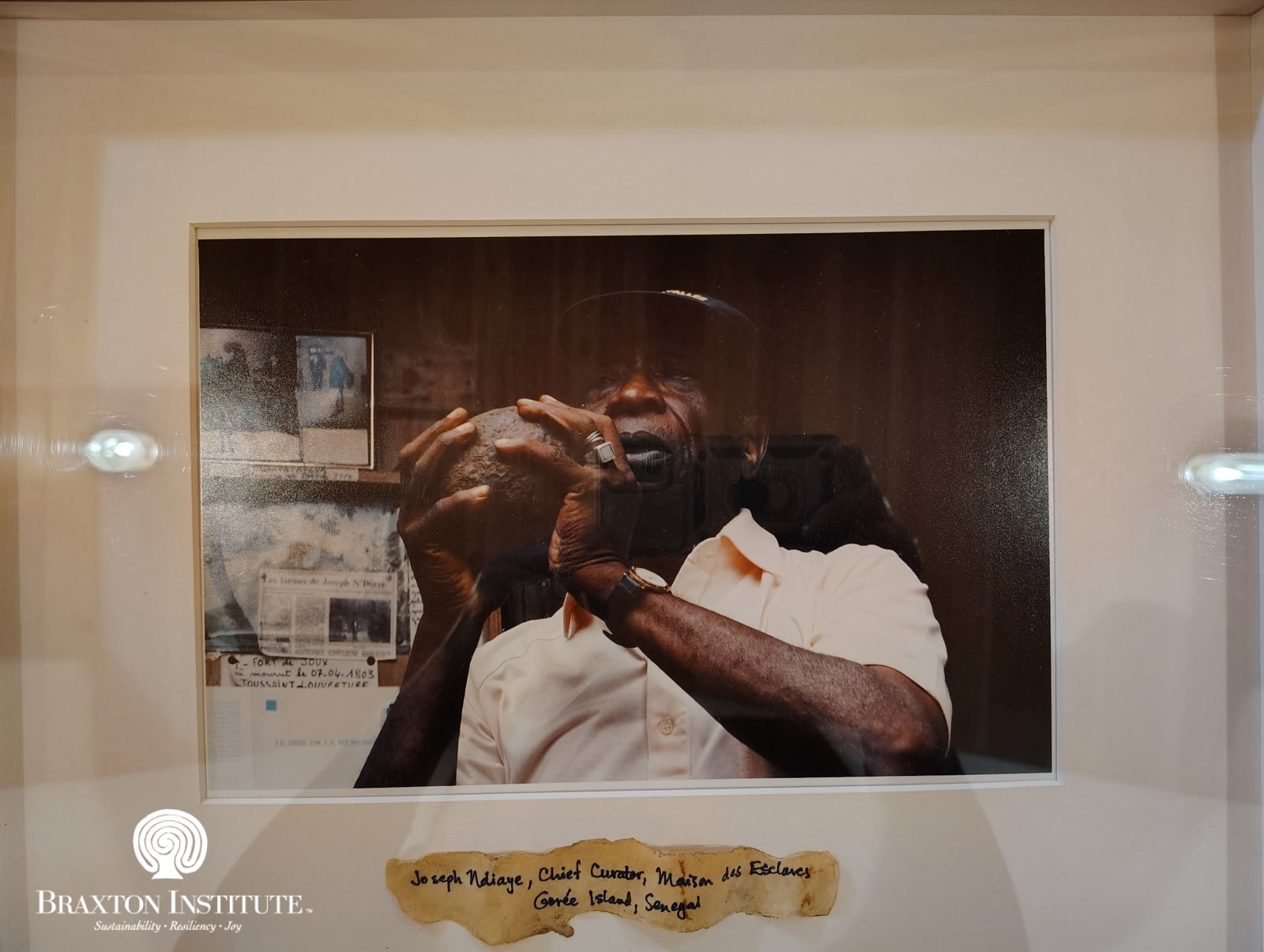
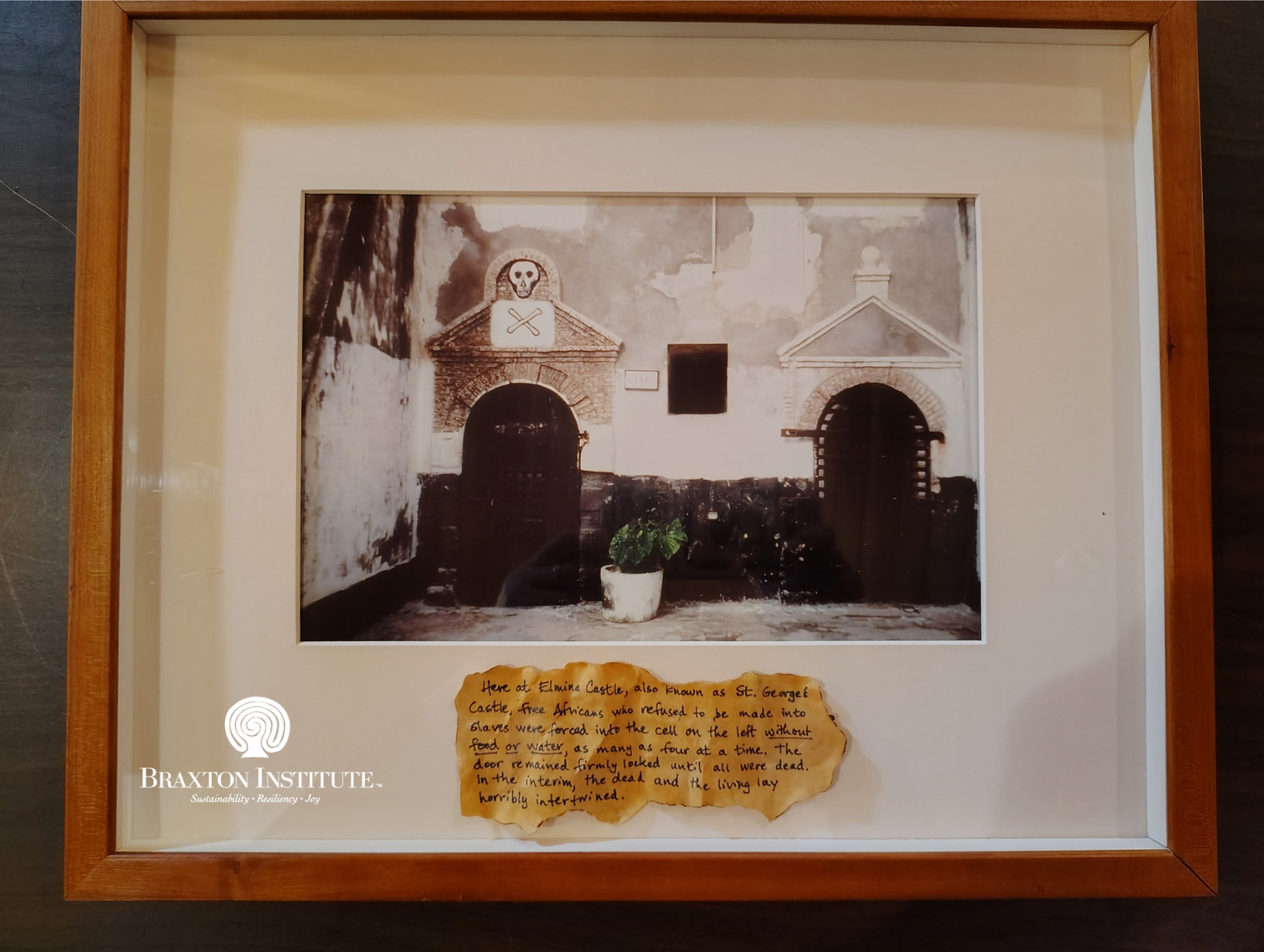
At Elmina fortress, there is a barred room with a skull and crossbones over the door. As many as four men at a time might be put into that room without food or water; the door was never opened as long as any one lived. What price resistance, to be the last alive among the dead? At Cape Coast fortress there is, in fact, a priest who keeps an altar of remembrance like the priest in Haile Gerima’s independent film SANKOFA. Pittsburg Africans on this Urban League sponsored pilgrimage (some black, some white) filed into his sanctuary and watched respectfully while he poured libations and invoked the spirits. Every one of us left some small offering, usually cash. Goree has its own punishment chamber – small, dark and solitary; its height prohibits standing. Anyone who believes with French Pierre Nora that, “We speak so much of history because we have so little of it left,” should enter that room and close the door.
In order to get well again as a people, whether as people of a common heritage or many peoples honoring a particular heritage, we must open the doors of the most private chambers of the soul and dare to engage a fragmented but collective past. Once one has been to Cape Coast or Goree, one sees Africa more readily in Liverpool or New London, in Muenster, Germany or Hanover, New Hampshire, in Paris, or St. Louis, in Haarlem or New Amsterdam – not to mention Cuba, Puerto Rico, Barbados and in the Sea Islands of South Carolina or Virginia’s Dismal Swamp. Even the place names have memory: in Bahia, Brazil, for example, one remembers that the Pelhourino district is called by that name, pelhourino, place of punishment, because our very cousins were flayed and scourged there.
I therefore recommend visiting these “sites of memory” to others similarly afflicted with unanswerable questions about the past and manifestations of the past in the present. White American authors have done the same: Hawthorne, for example, returned to Salem to write The Scarlet Letter, his novel of atonement. For those who cannot travel abroad, there is travel at home just as Thoreau “traveled much” in Concord. Was there a whipping post or auction block in the place where you live? Do streets of your city carry repressed and embedded narratives? Have you told your children the whispered stories that were passed down to you? What I learned in Africa, I think, is not only the importance of making the journey, but the importance of making and keeping rituals of remembrance.